
How to Check If a Car Has Been in an Accident
Three checks from Elso’s inspection video, a practical bodywork guide and the limits of accident-history reports.
What matters most
- Combine the car’s documents, physical condition and an independent inspection. One clean report cannot prove that a car has never been damaged.
- Elso’s video shows three useful clues: disturbed paint on fasteners, damaged headlight brackets and seatbelt labels that need an explanation.
- Cosmetic paintwork and structural repairs are different. Ask what happened, what was repaired and who checked the result.
A shiny bonnet can hide a complicated history. When you check if a car has been in an accident, the aim is to find inconsistencies before you commit: a seller’s explanation should match the paperwork and the vehicle in front of you.
You do not need to become a panel beater to ask better questions. Start with the checks below, then let a qualified body repair specialist assess anything you cannot confidently explain.
In this guide
Start with the car’s identity and repair history
Ask to see the registration documents and match the VIN to the vehicle. Ask who owns it, whether finance is outstanding, and whether it has had body, structural or restraint-system repairs. Request repair invoices and inspection reports where relevant; “it was only a small bump” is an explanation to verify.
Look at the service book and invoices together. Dates and mileages should form a believable sequence. Maintenance records will not list every body repair, but they help establish whether the story is consistent. If identification numbers look altered or do not match, pause the transaction and get the discrepancy properly verified.
Three accident-repair clues demonstrated by Elso Cars
Watch the inspection, then use the checks
In this short video, our team shows where to look under the bonnet and inside the car. These are screening clues, rather than a diagnosis from a single mark.
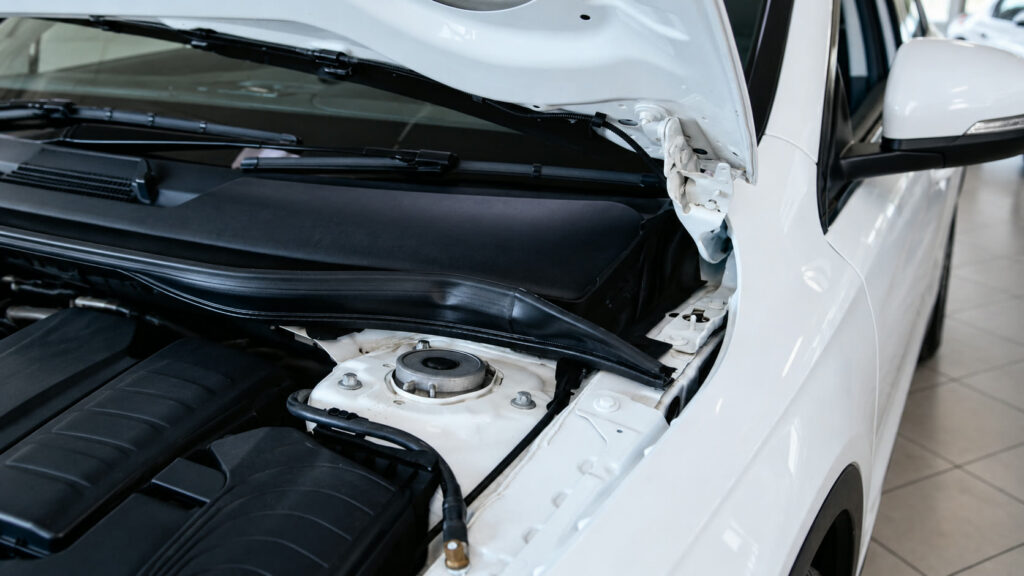
1. Disturbed paint around bolts
Look at the painted fasteners around the bonnet hinges and fenders. Tool marks or a broken paint edge can suggest that a panel has been loosened. Compare the two sides and nearby fasteners rather than judging one bolt in isolation.
The presenter makes an important qualification: a panel may have been adjusted for alignment. A disturbed bolt tells you to ask why it moved. It does not tell you how serious a repair was.
2. Broken or repaired headlight brackets
With permission, inspect the visible headlight mounting points. A cracked, glued or replaced bracket deserves a closer look, particularly if the same corner also has mismatched paint or uneven panel gaps. Do not dismantle the car to investigate it yourself; ask a specialist to assess inaccessible areas.
3. Seatbelt labels that need explaining
The video shows the date information on a seatbelt label. Compare visible labels and ask about replacements if something seems inconsistent with the vehicle’s age. Production dates need not exactly match the registration year, and belts can be replaced for reasons other than a collision. A label is a prompt for documentation, not proof of deployment or accident damage.
Compare the whole car in daylight
Inspect a clean, dry car in good light. Stand back to compare colour and alignment, then move closer. A cluster of clues is more useful than a single cosmetic blemish.
| Where to look | What deserves a question | What to do next |
|---|---|---|
| Paint and panel edges | Different texture, overspray on seals, uneven gaps | Ask which panels were painted and request the repair record. |
| Boot floor and spare-wheel well | Ripples, unusual seams, fresh paint or dampness | Have a body specialist check the rear structure and leaks. |
| Engine bay | Uneven seams, bent supports or several disturbed fasteners | Ask for an assessment of the front structure. |
| Tyres and test drive | Uneven wear, steering pull, vibration or unstable braking | Investigate alignment, suspension and tyres; there may be several possible causes. |
| Safety systems | Airbag warnings, damaged belts or an unexplained restraint repair | Get qualified diagnostic and safety-system checks before proceeding. |
A replaced windscreen, bumper respray or new headlight may have an ordinary explanation. Ask for specifics. Conversely, an apparently tidy exterior cannot rule out repairs underneath.
A clean VIN report does not mean accident-free
History services vary in their data and coverage. Read what the report actually checks and when its records were updated. Private repairs, uninsured damage and information outside the provider’s dataset may not appear.
There is also a specific South African limitation: SAIA’s 2025 annual review says Code 2 salvage records were excluded from its public VIN Lookup system. A Code 2 description or an absent lookup result should therefore never be your only reassurance.
Use this three-part check: Does the seller’s explanation match the documents? Do those documents match the vehicle? Does an appropriately qualified inspection support both?
Ask for the inspection that answers your concern
A roadworthy certificate and a detailed pre-purchase inspection serve different purposes. DEKRA offers roadworthy testing separately from its technical inspection. Even a detailed inspection has limits, including parts that are not dismantled.
For suspected collision repairs, tell the inspector exactly what worries you. Ask whether the scope includes underbody and structural observations, paintwork, alignment and relevant safety-system diagnostics. Get findings in writing, with photographs where possible. Do not assume that a general mechanical check includes a specialist structural assessment.
Pause if the seller refuses a reasonable independent inspection, changes the repair story, pressures you to pay first or cannot resolve an identity mismatch. If you are uncomfortable with the evidence or repair quality, keep looking.
Questions to ask before you decide
- Which panels or safety components have been repaired or replaced?
- Are the repair invoices and any before-and-after photographs available?
- Who assessed the structure and restraints after the work?
- Can I arrange an independent inspection before making a commitment?
- Will the agreed repair disclosures be included in the sale paperwork?
At Elso Cars, our published vehicle-selection standards state that we do not accept accident-damaged stock and check for structural repairs, panel resprays and chassis damage before buying. Ask our team to explain the checks on the specific car you are considering. For the rest of the buying process, use our used-car inspection checklist.
Frequently asked questions
Does a respray prove that a car was in an accident?
No. Paintwork may address scratches, stone chips or cosmetic damage. Ask why it was done and look for supporting records and other clues. A specialist can help distinguish cosmetic work from more serious repairs.
Can I prove a used car has never had accident damage?
No single visual check, registration code or history report can provide that certainty. You reduce uncertainty by combining records, direct questions and appropriate independent inspections.
Should I accept a car with a repaired bumper?
Assess the actual work and disclosure rather than the word “bumper.” Establish whether damage was limited to cosmetic parts or involved supports, sensors or structure. If unsure, have the repair assessed before buying.
Sources reviewed 8 October 2026: Elso Cars’ inspection video and FAQ, SAIA’s 2025 annual review, and DEKRA’s roadworthy and technical-inspection service descriptions. This guide helps you ask better questions; a remote article cannot assess an individual car’s safety.